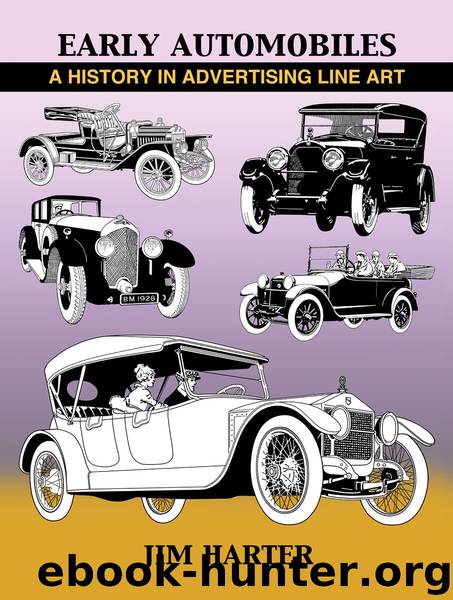
Early Automobiles by Jim Harter
Author:Jim Harter
Language: eng
Format: epub
Publisher: Wings Press
Published: 2015-04-14T04:00:00+00:00
CADILLAC AND LASALLE
Cadillac’s origins lie in the 1899 creation of the Detroit Automobile Co. by Henry Ford and a group of wealthy Detroit investors. The firm was reorganized as the Henry Ford Co. on Nov. 30, 1901. However, early the next year his backers turned against him because he seemed more intent on racing cars than producing them. When they brought in Henry Martyn Leland, of the Leland & Faulconer firm, to give an appraisal, Ford reacted angrily and quickly resigned. His investors were intent on dissolving the firm, but were persuaded by Leland to keep going. To convince them, he brought along a 1-cylinder 10-hp engine that he had built earlier to show Ransom E. Olds. It was an improvement over an Olds engine slated for Leland & Faulconer production, but Olds preferred to stick with his original design, leaving Leland with his prototype. It was this that convinced Ford’s former backers to stay the course. Their firm was reorganized as Cadillac Automobile Co., and Leland’s engine powered its first cars.
The original arrangement with Leland & Faulconer was for them to be the suppliers of engines, steering gears, and transmissions. However, while that part ran smoothly, the assembly operation at Cadillac didn’t. In October 1905, Leland & Faulconer and Cadillac were merged to become Cadillac Motor Car Co., with Leland becoming general manager. Leland was a perfectionist and his background was in precision engineering. Born to a Quaker family in Barton, Vermont, on Feb. 16, 1843, he had worked at Samuel Colt’s gun factory in Hartford, Connecticut, and later for Brown & Sharpe, a Rhode Island tool and machinery company. Coming to Detroit in 1890, Leland became associated with Robert C. Faulconer, a wealthy lumberman, and Charles H. Norton, a tool designer. Although specializing in precision gear manufacture, their firm engaged in other kinds of production, including both steam and gasoline engines.
Cadillac’s first Model A, a runabout with detachable tonneau, was completed Oct. 17, 1902. Priced at $750, it was taken to the New York Automobile Show in January 1903, and 2,286 orders were taken. A 1-cylinder Model B was added to the lineup in 1904. For 1905, Cadillac offered the 1-cylinder Models B, C, E, and F, and the 4-cylinder Model D, the latter available only as a 5-passenger tonneau. Using a shaft drive, its 300.7 cubic inch L-head engine developed 30-hp. The 1-cylinder lettered models were serial improvements over the original Model A. Throughout this evolution, the wheelbase length gradually extended and a longer hood took shape. Runabout, tonneau, surrey, and delivery body styles were available in 1905. Cadillac’s first Limousine was offered for 1906.
Having standardized and interchangeable parts was one of Leland’s immediate goals and in 1908 Cadillac became the first automobile company in the world to achieve it. That year, F.S. Bennett, Cadillac’s London dealer, staged an innovative test. He had three 1-cylinder Cadillac cars dismantled under Royal Automobile Club supervision at Brooklands. The parts were mixed together and then three cars re-assembled from them. All started up immediately and were then run on the Brooklands track.
Download
This site does not store any files on its server. We only index and link to content provided by other sites. Please contact the content providers to delete copyright contents if any and email us, we'll remove relevant links or contents immediately.
The Great Music City by Andrea Baker(32609)
Aircraft Design of WWII: A Sketchbook by Lockheed Aircraft Corporation(32333)
Call Me by Your Name by André Aciman(20602)
The Secret History by Donna Tartt(19294)
The Art of Boudoir Photography: How to Create Stunning Photographs of Women by Christa Meola(18688)
Shoot Sexy by Ryan Armbrust(17788)
Plagued by Fire by Paul Hendrickson(17462)
Portrait Mastery in Black & White: Learn the Signature Style of a Legendary Photographer by Tim Kelly(17052)
Adobe Camera Raw For Digital Photographers Only by Rob Sheppard(17031)
Photographically Speaking: A Deeper Look at Creating Stronger Images (Eva Spring's Library) by David duChemin(16735)
Ready Player One by Cline Ernest(14773)
Pimp by Iceberg Slim(14665)
Bombshells: Glamour Girls of a Lifetime by Sullivan Steve(14136)
The Goal (Off-Campus #4) by Elle Kennedy(13780)
Art Nude Photography Explained: How to Photograph and Understand Great Art Nude Images by Simon Walden(13092)
Kathy Andrews Collection by Kathy Andrews(11971)
The Priory of the Orange Tree by Samantha Shannon(9205)
The remains of the day by Kazuo Ishiguro(9083)
Thirteen Reasons Why by Jay Asher(8996)
